
& Hazards Lab

Compound Flooding in Coastal Watersheds
This research addresses the complex reality that coastal communities face simultaneous threats from multiple flood sources - riverine flooding, storm surge, and precipitation - that can amplify each other's impacts. Using advanced statistical modeling approaches, including Bayesian networks and copula-based methods, together with hydrodynamic simulation, this work develops frameworks to predict probable combinations of coastal and riverine flood drivers based on tropical cyclone characteristics and historical data. The research moves beyond conventional single-hazard approaches to quantify compound flood hazards in highly urbanized coastal watersheds, with particular focus on understanding how anthropogenic changes and climate impacts influence the temporal relationships between different flood sources. This work is critical advancing the resilience of communities located along the U.S. Atlantic Coast and globally, providing scientific foundations for identifying the dominant factors that will drive future flood risk.
Modeling Multi-Source
Flood Risk
We examines how rainfall, riverine flooding, and storm surge interact to heighten flood impacts in coastal areas. It moves beyond single-hazard models to capture the true complexity
of flood risk.
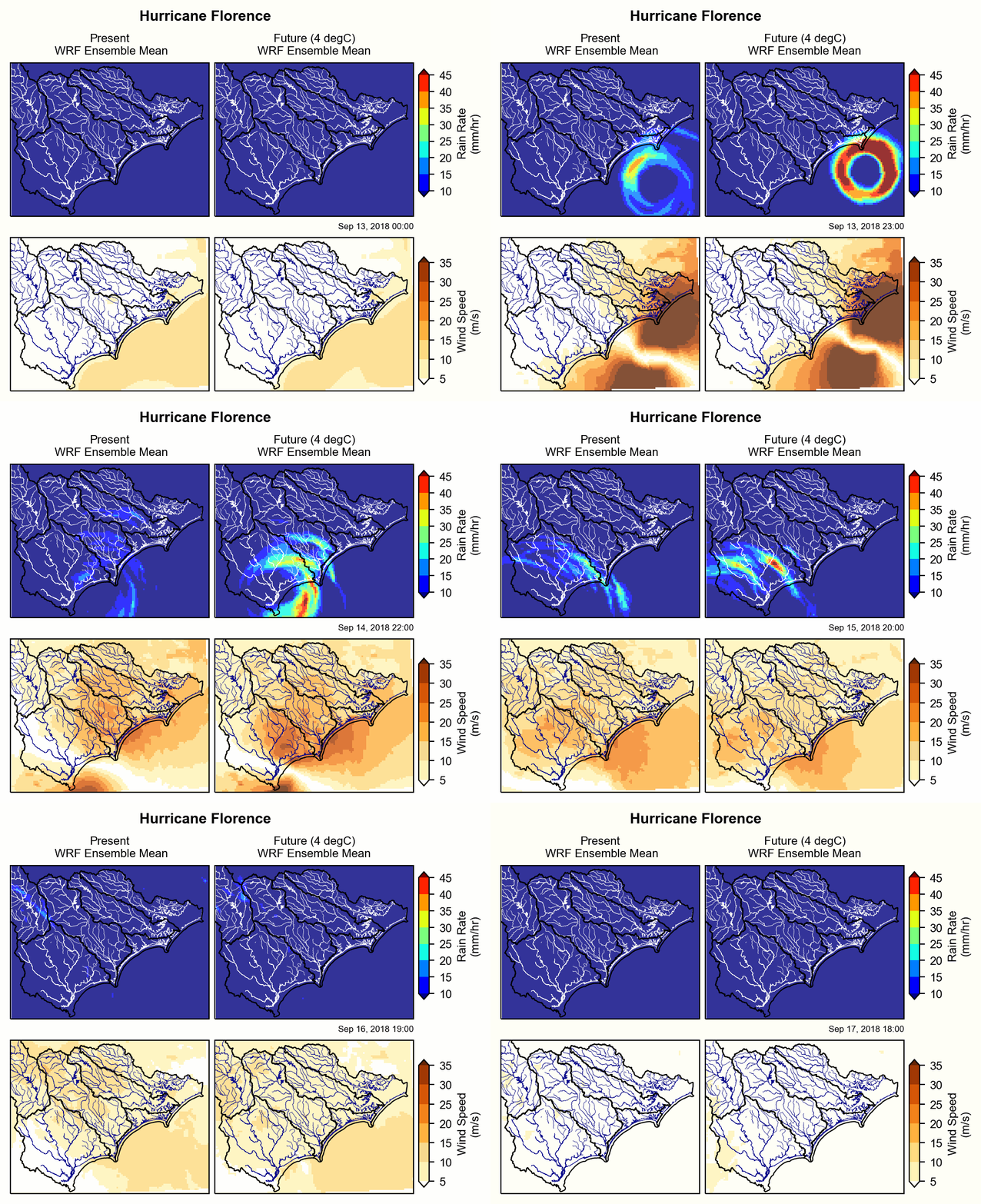
(Hollinger et al. 2024)
Predicting Compound
Flood Events
Using statistical tools like Bayesian networks and copulas, this work forecasts how different flood drivers combine during storms. The models help anticipate high-risk scenarios in urban coastal watersheds.

.
Adapting to Complex
Flood Hazards
Our research identifies how human and environmental factors shape compound flooding, Supports smarter planning for vulnerable coastal communities.

.
Relevant Publications
Grimley, L. E., Sebastian, A., Leijnse, T., Eilander, D., Ratcliff, J., & Luettich, R. (2025). Determining the relative contributions of runoff, coastal, and compound processes to flood exposure across the Carolinas during Hurricane Florence. Water Resources Research, 61(3), e2023WR036727.
Grimley, L. E., Hollinger Beatty, K. E., Sebastian, A., Bunya, S., & Lackmann, G. M. (2024). Climate change exacerbates compound flooding from recent tropical cyclones. npj Natural Hazards, 1(1), 45.
Wang, C., Pavelsky, T.M., Yao, F., Yang, X., Zhang, S., Chapman, B., Song, C., Sebastian, A., Frizzelle, B., Frankenberg, E., Clinton, N. (2022). Flood Extent Mapping During Hurricane Florence With RepeatPass LBand UAVSAR Images, Water Resources Research, 58(3), e2021WR030606, doi: 10.1029/2021WR030606
Mobley, W.+, Sebastian, A.+, Highfield, W.E., Brody, S.D. (2019) Estimating Flood Extent during Hurricane Harvey using Maximum Entropy in a Hazard Distribution Model. Journal of Flood Risk Management, doi: 10.1111/jfr3.12549. +these authors contributed equally to this work
Couasnon, A.A., Sebastian, A., Morales-N´apoles, O. (2018) A copula-based approach for modeling stochastic boundary conditions in a coastal catchment: An application to the Houston Ship Channel, Texas. Water (Special Issue: Copulas in Hydrology), 10(9), 1190-1209. doi: 10.3390/w10091190.
Highfield, W.E., Sebastian, A., Vieux, B. (2018). GIS Applications in Hydrology. In Chapter 10, Hydrology and Floodplain Analysis, 6th ed. by Philip B. Bedient, Wayne Huber, & Baxter Vieux. Upper Saddle River, NJ: Prentice Hall, pp. 617-644.